The assessment that keeps restarting
Ask a risk team where their week goes and the answer is rarely “judgement”. It goes into restating requirements that the framework already defines, reformatting findings, and rescoring risks that a colleague would have scored differently. Scoring drifts between analysts and between projects, the backlog grows faster than the team, and review quality becomes whatever time is left at the end.
Describe the project once
The alternative is to make the framework do the repetitive part. In SynapseRM, a project assessment runs through five steps:
- 01 · Project scope. Context, data, assets and exposure, captured once.
- 02 · Security requirements. Derived automatically from the framework you use, so the baseline is identical from one project to the next.
- 03 · Findings. Gaps recorded against that requirement baseline as the questions are answered.
- 04 · Scored risks. Likelihood and impact on one consistent scale, with an owner and a treatment proposal.
- 05 · Registry. The reviewed risks land in the register, tracked to mitigation or acceptance.
The analyst's job changes shape. Instead of writing a register from scratch, they review one: they challenge the scoring, adjust the context, and spend their expertise where it actually matters.
What changes in practice
- Days become hours. The typical time to a reviewed project risk register drops from days of writing to hours of review.
- One scale. Scoring is consistent across every analyst and every project, so registers can finally be compared and aggregated.
- Frameworks out of the box. Several assessment frameworks are supported natively (ISO 27001/27005, NIS2, DORA, NIST, CIS, NESA), and scales, fields and workflows can be configured to your own method.
Inside the assessment
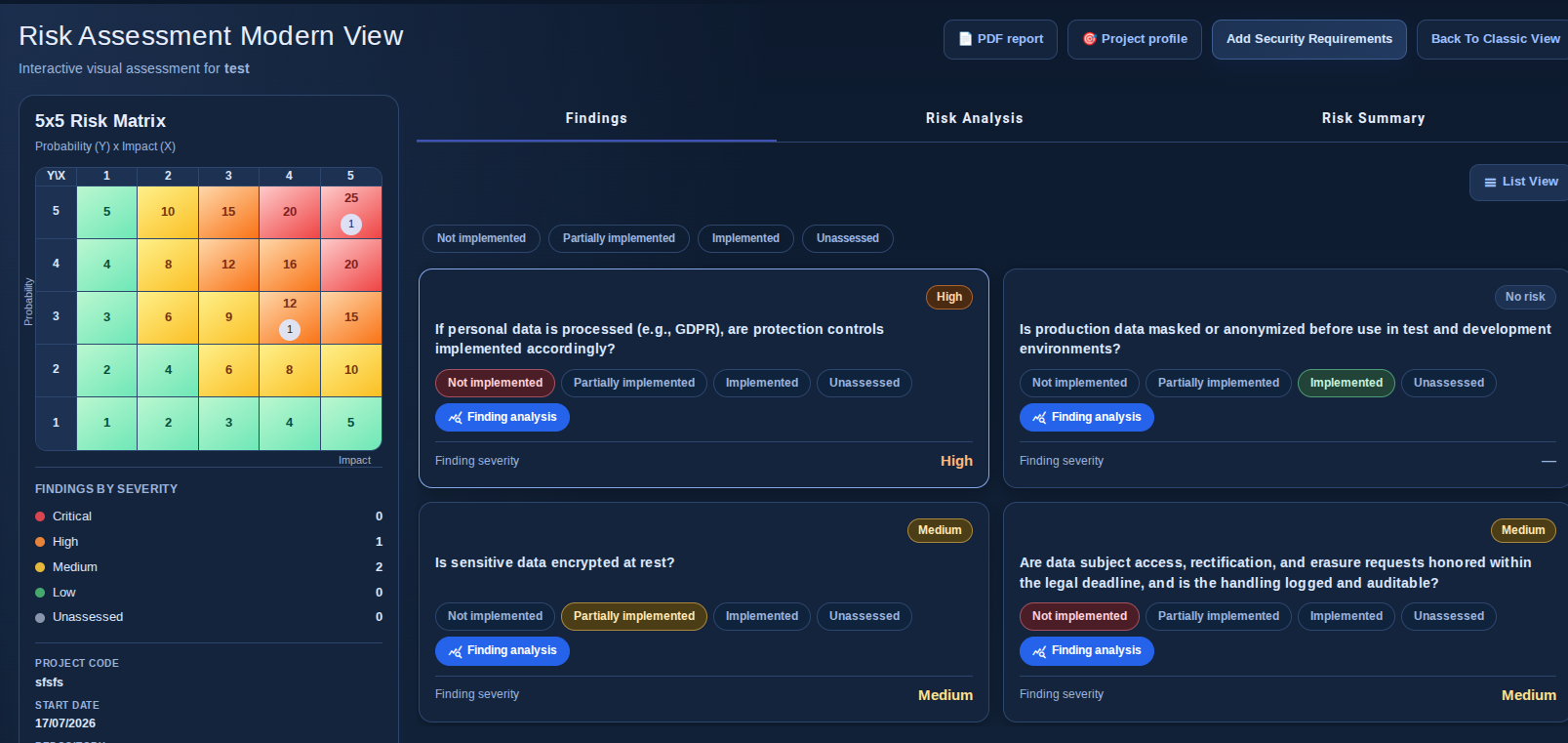
The assessment view keeps the analyst in one screen: each requirement is answered in place, each finding gets a rated severity through the finding analysis, and the 5×5 risk matrix populates live as findings are scored. When the review is done, a PDF report for the project is one click, and the risks are already in the registry.
Automation here does not replace the analyst. It removes the part of the job that was never analysis in the first place.
In a 45-minute session we run your own scope through SynapseRM: requirements, findings, scored risks, register entry. You keep the output either way.

A Belgium-based provider of cybersecurity solutions, and the team behind SynapseRM / TPRM.